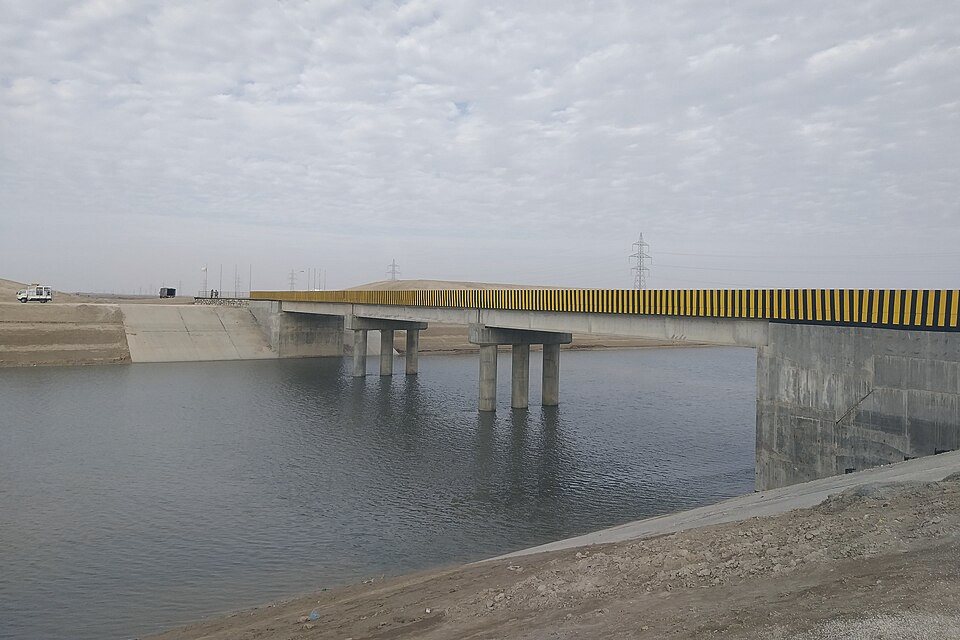

On 28 October 2026 the English-language portal The Astana Times published an article by Hamzah Rifaat on the Qosh Tepa canal and the threat it poses to water security in Central Asia.
Mezon’s analysis desk has read it for you and offers a short summary.
How the Afghan canal is changing the region’s water balance
The author argues that the construction of the Qosh Tepa canal in Afghanistan has become a challenge to Central Asia’s water security, and explains why.
Its designers intend Qosh Tepa to solve the water problem for Afghan farmers. The trouble is that the canal will take a substantial volume of water from the Amu Darya, and the countries further downstream will simply not have enough of it.
According to the article, the canal starts on the Amu Darya in Afghanistan’s Balkh province and runs through Jawzjan and Faryab, ending in the Andkhoy district. It was first conceived in the 1970s under President Daoud Khan, and feasibility studies were carried out in 2020. After the Taliban took power in 2021, their interim government made the project one of its priorities.
The canal is 285 kilometres long, 100 metres wide and 8.5 metres deep. It is paid for out of Afghanistan’s own revenues, including customs duties and taxes.
According to Afghanistan’s National Development Corporation, by the time the article was published the earthworks of the second phase were 98 per cent complete, and the embankments and slopes were 90.5 per cent ready.
Kabul’s unilateral decisions breed mistrust
The main problem is not Afghanistan’s wish to develop its agriculture as such, but the way the project is being carried out.
The Taliban ignore the existing mechanisms for sharing water in the region and did not agree the construction of Qosh Tepa with their neighbours.
The author also points to engineering risks. The canal has no concrete lining and no proper bank reinforcement. As a result, a large share of the water may seep away into the sandy soil.
So the project creates a double problem. It can increase how much water Afghanistan withdraws while making the use of that water less efficient, at a time when water is already growing scarce.
Uzbekistan among the most vulnerable
In the author’s view, Uzbekistan stands to lose the most.
In March 2026, Uzbekistan’s minister of water resources, Shavkat Khamraev, warned that Afghanistan could withdraw around four billion cubic metres of water a year, which could cause serious problems for the country’s agriculture.
Karakalpakstan and Khorezm, where farming depends on the Amu Darya, would be hit hardest. Rural districts would simply dry up.
The long drying of the Aral Sea makes the situation worse. The author cites the Tuyamuyun reservoir, where the volume of water has fallen by more than 600 million cubic metres. Shrinking reserves also raise the risk of salinisation.
The Astana Times also points to climate change. Uzbekistan has to cope at the same time with rising temperatures, melting glaciers, seasonal swings in river flow and the threat of glacial lake outburst floods.
Qosh Tepa will also be felt in Turkmenistan and Tajikistan.
The author believes the problem can be solved by working together with Afghanistan. But is Kabul ready for that kind of arrangement?
What can Central Asia do?
According to the author, the Qosh Tepa project is nearing completion, with 2028 set as the latest date for finishing construction. That leaves almost no time to work out a common approach.
What needs to be done? The article puts forward four options.
- Start a dialogue on the Amu Darya with Afghanistan, the relevant ministries and technical experts.
- Develop a practical mechanism for managing water resources, including procedures for settling disputes.
- Monitor how the canal operates, to keep track of water withdrawals and keep disagreements to a minimum.
- Cooperate on efficient irrigation, to reduce water losses and share water in a consistent way, with no surprises for the neighbours.
These options will only work once Kabul says it is willing to talk.
The Central Asian states should also move as soon as possible from words to concrete talks with the Taliban on water use. Without constant dialogue, monitoring and agreed rules, Qosh Tepa could become a source of long-term tension across the whole region.