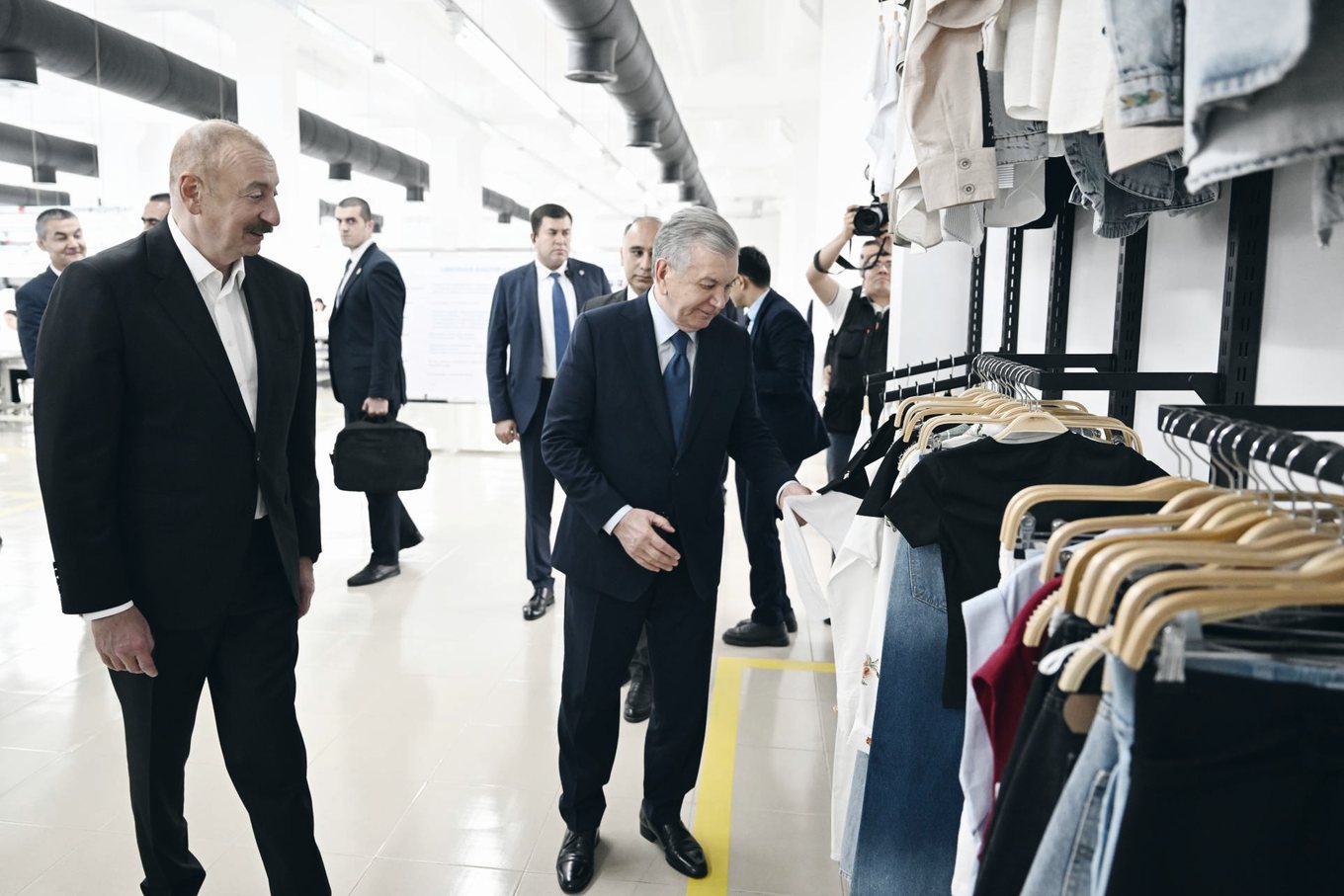

Uzbekistan has become the first country in Central Asia to sign a Treaty of Eternal Friendship with Azerbaijan. It happened back in August, during Azerbaijani President Ilham Aliyev’s visit to Tashkent.
The two sides set an ambitious goal: to raise trade to $1 billion by 2030.
In this piece we look at what exactly Tashkent and Baku plan to fill the “eternal friendship” with, what role the presidential families play in bringing the two countries closer, and why Azerbaijan’s growing weight will not change the balance of power on the regional map. Mezon Central has the details.
More than partners
Under Islam Karimov, cooperation between Uzbekistan and Azerbaijan grew as a partnership of shared interests. Its scope began to widen quickly in 2022 with an agreement on strategic partnership. In 2023 a Supreme Interstate Council was set up, and in 2024 the two sides signed a Treaty on Allied Relations. The final chord was the Treaty of Eternal Friendship.
Speaking to Mezon Central, Farhad Mammadov, director of the Center for South Caucasus Studies, said that “Baku and Tashkent show the highest level of cooperation”. According to the expert, Azerbaijan has always been consistent in building its foreign policy towards the region. It has allied relations with Kazakhstan and Kyrgyzstan and a strategic partnership with Tajikistan, where an investment fund has been launched for projects that matter to Azerbaijan. With Turkmenistan, Baku is developing cooperation in energy, transport and logistics. In November 2025 Azerbaijan joined the group of Central Asian states.
C6 is not about “friendship against someone”. It is about closer relations, stronger independence and economic development.
“The Treaty of Eternal Friendship with Uzbekistan will not change the balance of power in Central Asia. That balance is set by the countries of the region themselves. The more diverse their political and economic ties with outside partners, the more balanced Central Asia will be. The Central Asian states are the ones most interested in that. The region must not become a hotbed of rivalry between the big geopolitical players. Security has to be ensured both inside and along the outer perimeter, and, since the region has no access to the sea, strategic routes to the world market have to be built. It is the shared position of the Central Asian countries that creates the current balance,” Farhad Mammadov stressed.
But Central Asia needs Azerbaijan not only as a reliable partner that can pull the region out of its geographic dead end by opening a way to the sea. It also needs it as a guide in building an independent policy towards outside actors, Russia in particular. That is the view of Alisher Ilkhamov, head of the London-based research organisation Central Asia Due Diligence. Answering questions from Mezon Central, he said that Azerbaijan offers a model of distancing itself from Moscow step by step.
“That is the first reason. The second is the geography of Central Asia. After the war in Ukraine began, routes through Russian territory became limited because of sanctions and high risks. There was hope for rail transit through Afghanistan to Pakistan and beyond, but that project stalled when relations between Kabul and Islamabad worsened. So the only route that really works is the Trans-Caspian one. Azerbaijan plays the central role here: through its territory you can reach Turkey and also use the route through Georgia. Apparently, this is one of the main bets,” Alisher Ilkhamov said.
Economically, these logistics chains will complement each other.
In the frame and behind it
Behind the official political statements stand concrete economic projects, investments worth billions of dollars, transport chains, education initiatives and the growing interdependence of the two states. That is the angle from which we look at the document the presidents, Ilham Aliyev and Shavkat Mirziyoyev, signed in the last week of summer.
According to Uzbek and Azerbaijani media, Azerbaijan is bringing state capital into Uzbekistan through the oil company SOCAR and ABB bank, and private capital through Agalarov Development, Matanat-A, Landau Education Group and TuranAZ. On the Uzbek side, Uzbekneftegaz, Davr Bank, Gold Fresh Fruits and Sur Gold and Silver Project take part in individual projects.
We start with banking. ABB bought a controlling stake in Uzbekistan’s Davr Bank. The deal was signed by ABB’s chairman of the board, Abbas Ibrahimov, and Davr Bank’s founder, Lutfulla Ubaev, on the eve of the Azerbaijani leader’s visit, on 22 August 2026. The bank will now operate under the ABB Davr Bank brand.
Baku will also finance Uzbekistan’s strategic oil and gas sector through its state company, SOCAR, Azerbaijan’s largest state oil company. In Uzbekistan its partner is Uzbekneftegaz. SOCAR is starting a network of filling stations, five in the first phase. At the same time, an energy project for gas exploration and production will be developed on the Ustyurt plateau in Karakalpakstan.
Last year, at a meeting with university teachers, Shavkat Mirziyoyev announced the discovery of this much sought-after fuel at a record depth of 6.5 kilometres. But developing the field on its own proved too much for Uzbekneftegaz. “To turn these huge resources into products with high added value, we need above all science, knowledge and innovation,” the president admitted.
Ustyurt is by no means a new energy site for Uzbekistan. At various times since 2006, Gazprom worked there. The Russian company explored seven investment blocks, discovered the Dzhel field and took part in developing the Shakhpakhty field. Now Azerbaijan’s SOCAR is joining the development of the region.
“That is very good. In recent years Uzbekistan has become heavily dependent on Russia: since 2023 the republic has been importing Russian gas instead of exporting its own. The fields in use are running out, and new ones have to be developed. Tashkent first bet on Moscow and companies linked to it. In particular, an inclusive agreement was signed with Bakhtiyor Fazilov’s Eriell. The company was in effect under Moscow’s protection and served the interests of Russia and Gazprom. But there was a lot of abuse as the sector developed, and in the end the work did not bring the expected results. One version holds that by leading the Uzbek authorities to sell Fazilov’s oil and gas assets, Moscow made Tashkent dependent on gas supplies. But there is no direct evidence,” the expert Alisher Ilkhamov said.
A short digression: Bakhtiyor Fazilov did indeed play first fiddle in Uzbekistan’s oil, gas and infrastructure sector for a long time. But he has not been seen in the deals of the Uzbek-Azerbaijani business tandem.
Besides oil and gas, Azerbaijan is active in construction. The package of Azerbaijani state investments includes a building materials company, Matanat-A. It has built a gypsum plant, which was opened during Aliyev’s visit.
And finally, Landau Education Group, an Azerbaijani education group. Two Landau STEAM schools have opened under its banner in Tashkent.
Not without a “raisin”
Now to the private initiatives. At the top of the list is Sea Breeze Uzbekistan, in effect a new $5 billion resort town on the Charvak reservoir. It is being built by the Azerbaijani developer Emin Agalarov, son of the Russian billionaire Aras Agalarov, owner of Crocus Group. Emin was married to Ilham Aliyev’s elder daughter, Leyla. The couple officially divorced in 2015.
The Uzbek side of the project is represented by Ulugbek Makhmudov. He owns 50 percent of the Sea Breeze Uzbekistan joint venture, which makes him a co-founder. The joint venture was registered in Uzbekistan’s state register on 4 August 2025.
There is very little public information about Ulugbek Makhmudov. It is known that he was once deputy chairman of Uzbekoziqovqatzaxira, and that he now owns a number of companies: New Time-Projects (100 percent), 50 percent of Breeze Development and a small stake in Sunshine Investment. He is also a co-owner of several large projects.
How a businessman with almost no public profile came to own half of a $5 billion construction project is a mystery. In Uzbek reality, the sheer scale of the project and access to it suggest that Mr Makhmudov has serious connections in business circles close to the decision-makers.
Another private company on the investment list under the same Treaty of Eternal Friendship is Sur Gold and Silver Project. The company mines and processes silver-bearing ore. One of its participants is Mir Zellaybedin Aliyev. He also holds a stake in the Uzbek agricultural company Gold Fresh Fruits.
Gold Fresh Fruits was listed among the assets of Orient Group. One of Orient Group’s co-owners was Oybek Umarov, brother of President Mirziyoyev’s younger son-in-law, Otabek Umarov.
“After the failed assassination attempt on Komil Allamjonov, Otabek Umarov was removed from his post as deputy head of the presidential security service. But he did not lose his levers of influence over business. There is information that the president’s younger son-in-law gained control over certain oil and gas fields, and not only those. Unfortunately, nepotism is quite common in Uzbekistan’s politics and economy, and corruption remains high,” Alisher Ilkhamov said.
So behind the sign of multibillion investments stands a rather tight circle of people and business groups whose ties reach far beyond the projects themselves. Here is the son of a Russian billionaire and former son-in-law of Azerbaijan’s president, relatives of Uzbekistan’s president and businesspeople from their circle.
Formally this is about private business and investment. But the line-up itself makes one wonder how far the new economic ties between Tashkent and Baku are only about money and development, and how far they are also about redistributing influence among business elites politically close to the presidential houses.