Uzbekistan’s authorities have announced that by the end of the third quarter of 2026 the country’s GDP had grown by 8.3 per cent and exceeded 1.75 quadrillion soums. That would seem to be good news, but in reality things are not so simple. Inflation is still above the levels set by the country’s National Bank. At times it ends up halving the effect of the economy’s positive growth.
What is more, forecasts by Uzbek officials themselves and by international financial institutions alike say that by the end of this year GDP growth and inflation will be almost the same.
On top of that, the prices of fuel and basic services are rising sharply. This means that ordinary people in Uzbekistan hardly feel the economic growth: their wallets keep emptying much faster than they can register the country’s economic growth. But let us take things one at a time.
How prices rose
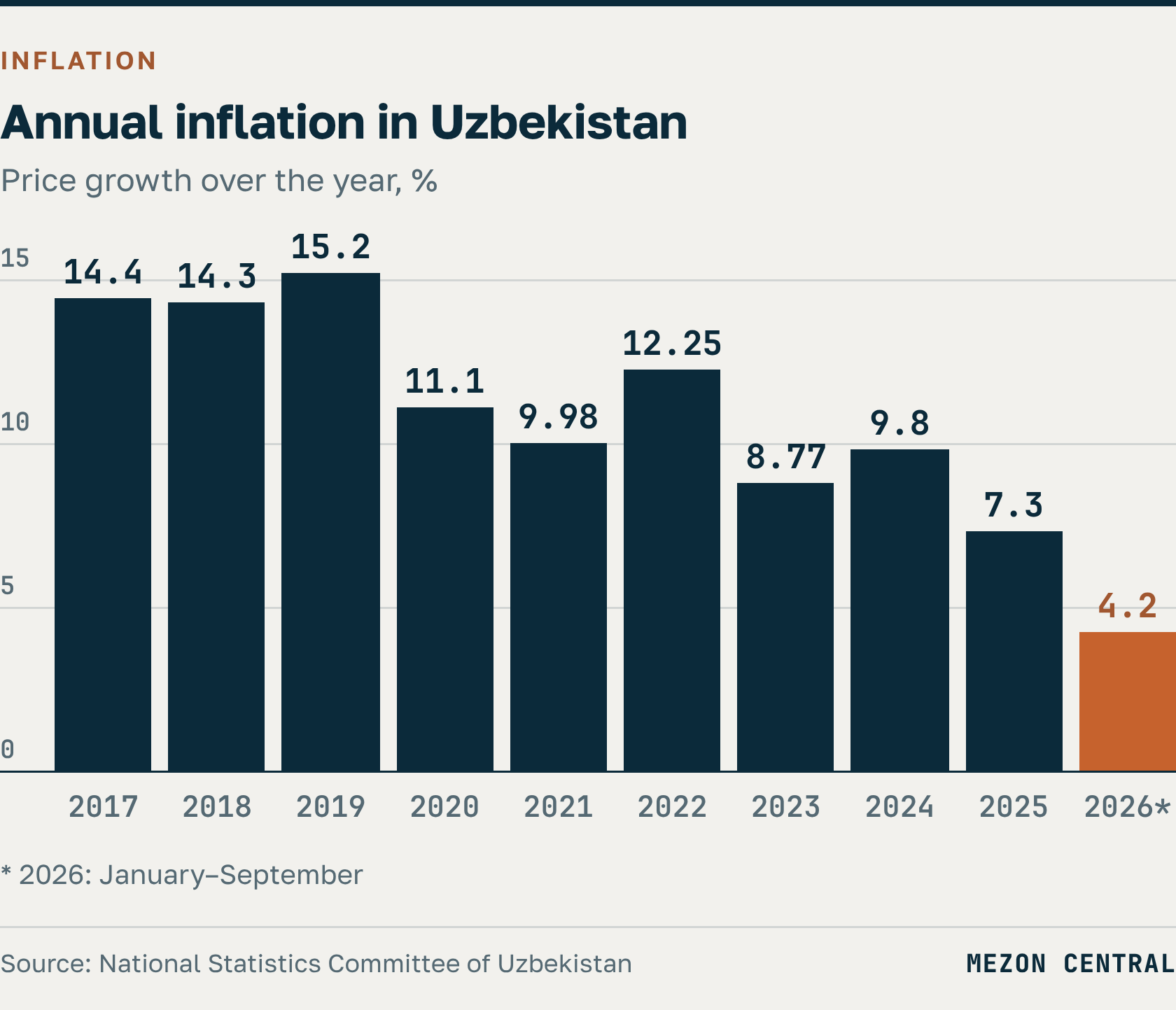
We studied the figures for annual inflation in Uzbekistan over the past ten years. And there is certainly something to be proud of here. Since 2017 price growth has fallen by more than half. Inflation was highest in 2019, when it reached 15.2 per cent. Since then the figure has gradually come down. Since 2023 it has not once exceeded 10 per cent. That in itself is a big plus.
What is more, consumer price inflation in January–September 2026 was 4.2 per cent. People have not seen figures like that for a long, long time. But it is too early to relax, because the full-year figures will very probably be considerably higher.
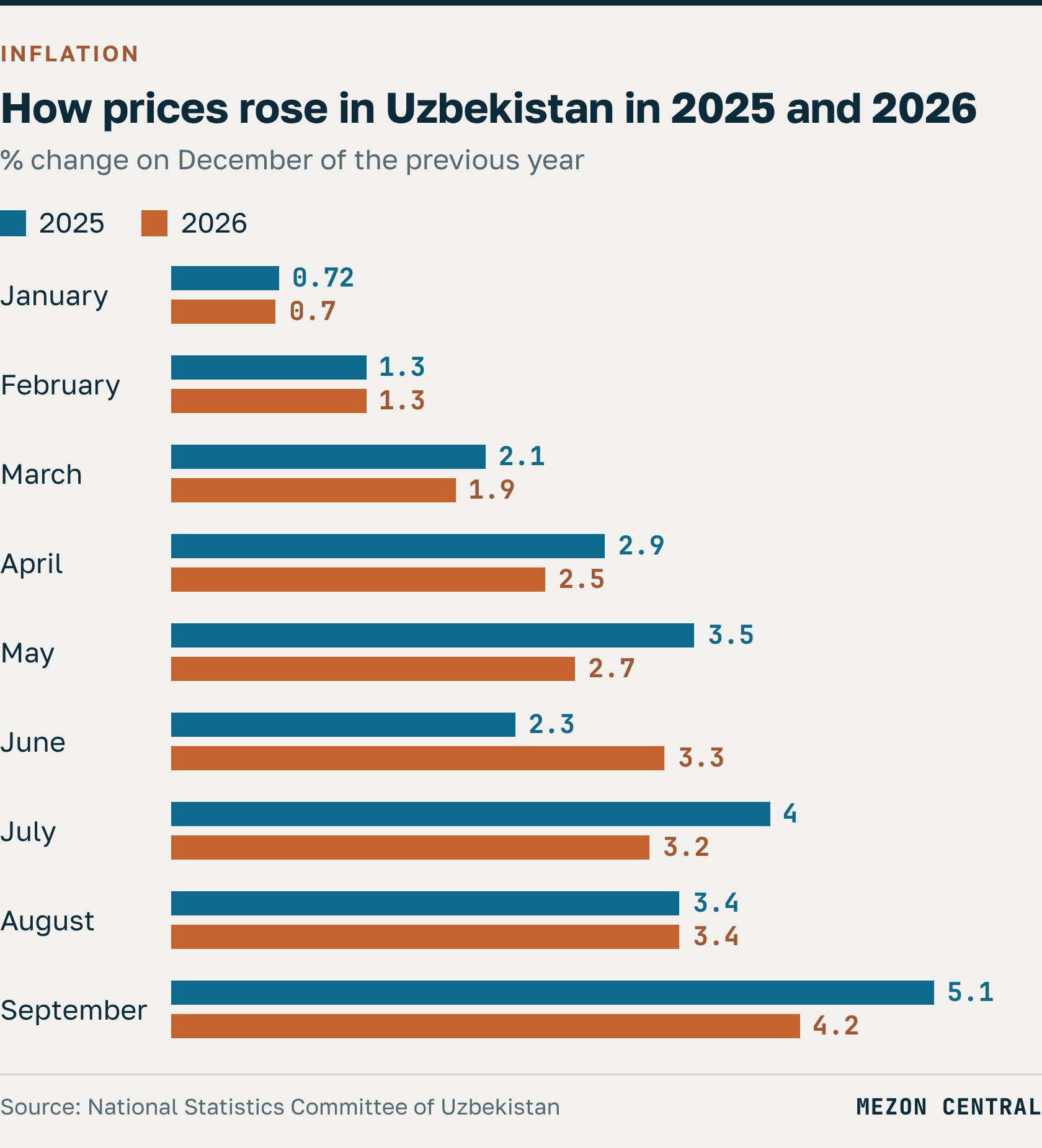
And this is where we need to be careful and not get too excited about the low rate of price growth. On the one hand, inflation this year really is much lower than in 2025. On the other, the data show that it keeps speeding up towards the end of the year. The National Statistics Committee confirms this too. According to its data, inflation in September was 0.7 per cent. That is the highest monthly figure since the start of 2026. The same figure was recorded only in January this year.
Over the year, Tashkent remained the leader for inflation. Prices in the capital rose by 7 per cent. In the Andijan and Fergana regions the figure was 6.7 per cent, in Khorezm 6.6 per cent, and in Kashkadarya and Samarkand 6.5 per cent. The lowest inflation was recorded in the Syrdarya region, at 5.4 per cent, and in the Bukhara region and Karakalpakstan, at 6 per cent.
Fuel, vegetables and meat once again
Year on year (September 2026 compared with September 2025), inflation was 6.4 per cent. In August this year the figure was 6.2 per cent. This again suggests that inflation in Uzbekistan has started to accelerate. But what is driving it?
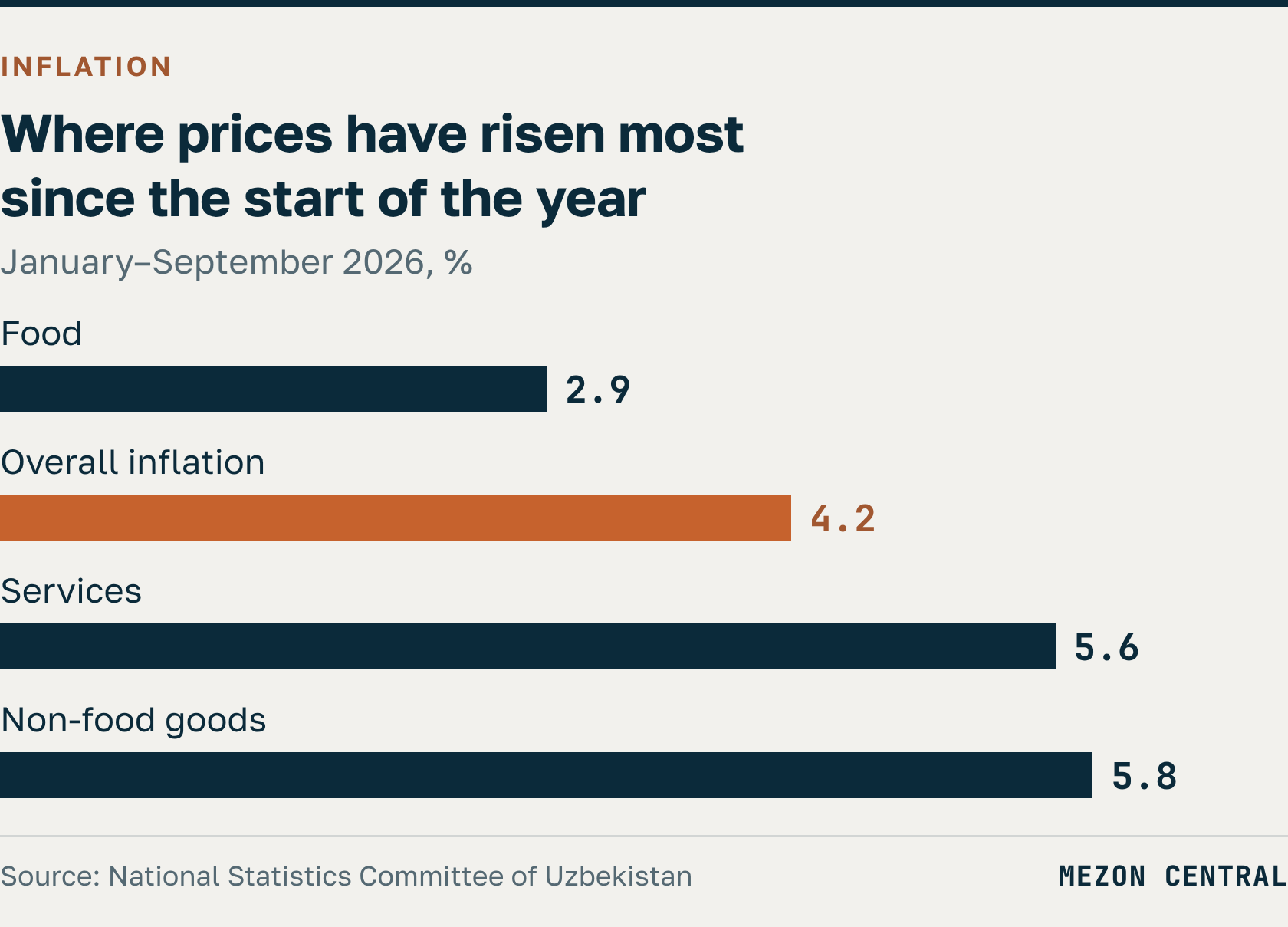
To understand what is happening to prices, the headline inflation figure alone is not enough. You have to look at the details. And they show that food prices rose by 2.9 per cent. Price growth in the two other categories, services and non-food goods, was much higher than the national rate of inflation: 5.6 per cent and 5.8 per cent respectively.
Food prices are not that simple either. Yes, overall they rose only slightly. But that is the average; in reality some categories of goods have become considerably more expensive. Above all meat, whose price is rising so fast that it is becoming a real delicacy on Uzbek tables.
The foods that rose most in price over the year:
- mutton: up 19.8 per cent
- boneless beef: up 17.9 per cent
- beef on the bone: up 16.2 per cent
- eggs: up 11.4 per cent
- buckwheat: up 8.3 per cent
So why was the overall rise in food prices relatively modest? The seasonal factor played a part. Vegetable and fruit prices fell, and that changed the overall picture.
Among non-food goods, it is fuel prices that are the most depressing. They are rising at a truly astronomical pace that GDP could only envy. Official data show that over the year (September 2026 compared with September 2025) petrol rose in price by 20.1 per cent, propane, which most motorists drive on, by 48.9 per cent (!), and methane by 10.1 per cent.
Among passenger transport services, long-distance train tickets rose in price by 11.6 per cent, while air fares, by contrast, fell by 6.7 per cent over the year.
Will prices come down?
What to expect next. The forecasts of the National Bank of Uzbekistan, the Ministry of Economy and Finance and international financial institutions are almost identical. For 2026 as a whole, inflation will be above 6 per cent. This means that GDP growth will outpace it by just a couple of percentage points. So much for development.
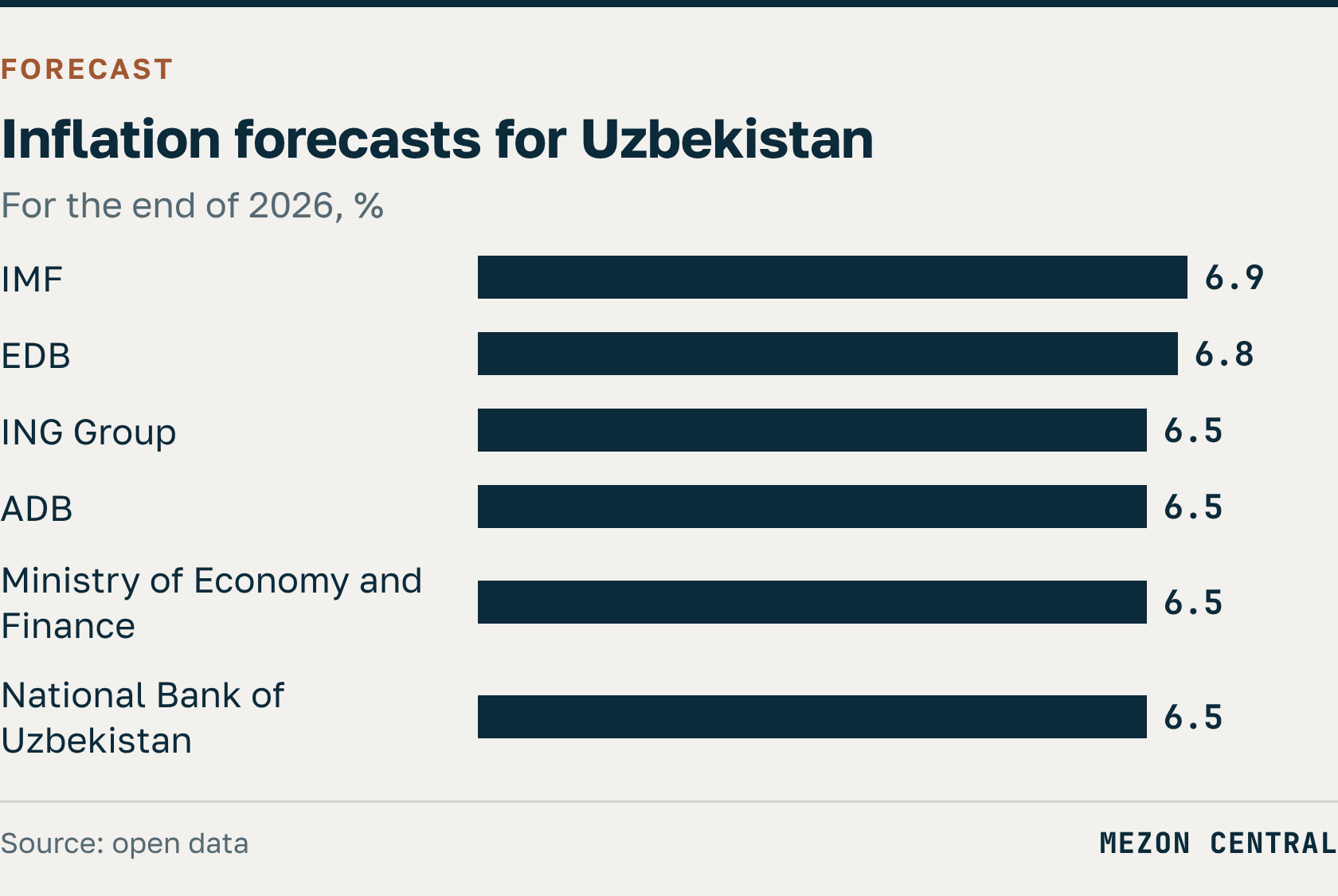
But there is good news too. The Eurasian Development Bank (EDB) expects inflation in Uzbekistan to slow in 2026–2028.
“Inflation will continue to decline under the influence of moderately tight monetary conditions and a stable exchange rate. At the same time, high domestic demand and rising world commodity prices will remain pro-inflationary factors. The stability of the national currency’s exchange rate will also help bring inflation down by restraining price growth for imported non-commodity goods and services. High oil and gas prices will put pressure on the cost of fertiliser and electricity, raising costs in agriculture, trade and freight transport. This may become a source of additional inflationary pressure in 2026–2027,” the EDB says.
The Asian Development Bank shares this view, which […] monetary policy to contain inflationary pressure and anchor inflation expectations. The ADB also notes that high domestic demand may also make it harder to bring inflation down.