
Uzbekistan’s authorities report that they have been fighting inflation hard for the past few years. Judging by the official figures, they are doing it quite successfully, too. But that is in dry numbers and reports. In real life, people’s wallets empty faster than their salary reaches their bank card.
Every trip to the shops makes a serious dent in the budget. Add the utility bills and the wish to get out of the house now and then for a walk, and things get rather gloomy.
Mezon Central worked out how much money it takes to live in Tashkent in comfort today, and it left us a little glum. You will not get far on the capital’s average salary. As for pensions, we would rather not say: there the question is not living well but getting by.
How prices have changed in Uzbekistan and Tashkent
We start with the official statistics. In October, consumer prices in Uzbekistan rose by 0.6%. Annual inflation picked up to 6.5%, from 6.4% in September.
Annual food price growth rose from 6.3% in September to 6.4%, and services from 7% to 7.3%. Annual inflation for non-food goods, by contrast, slowed from 5.8% to 5.6%.
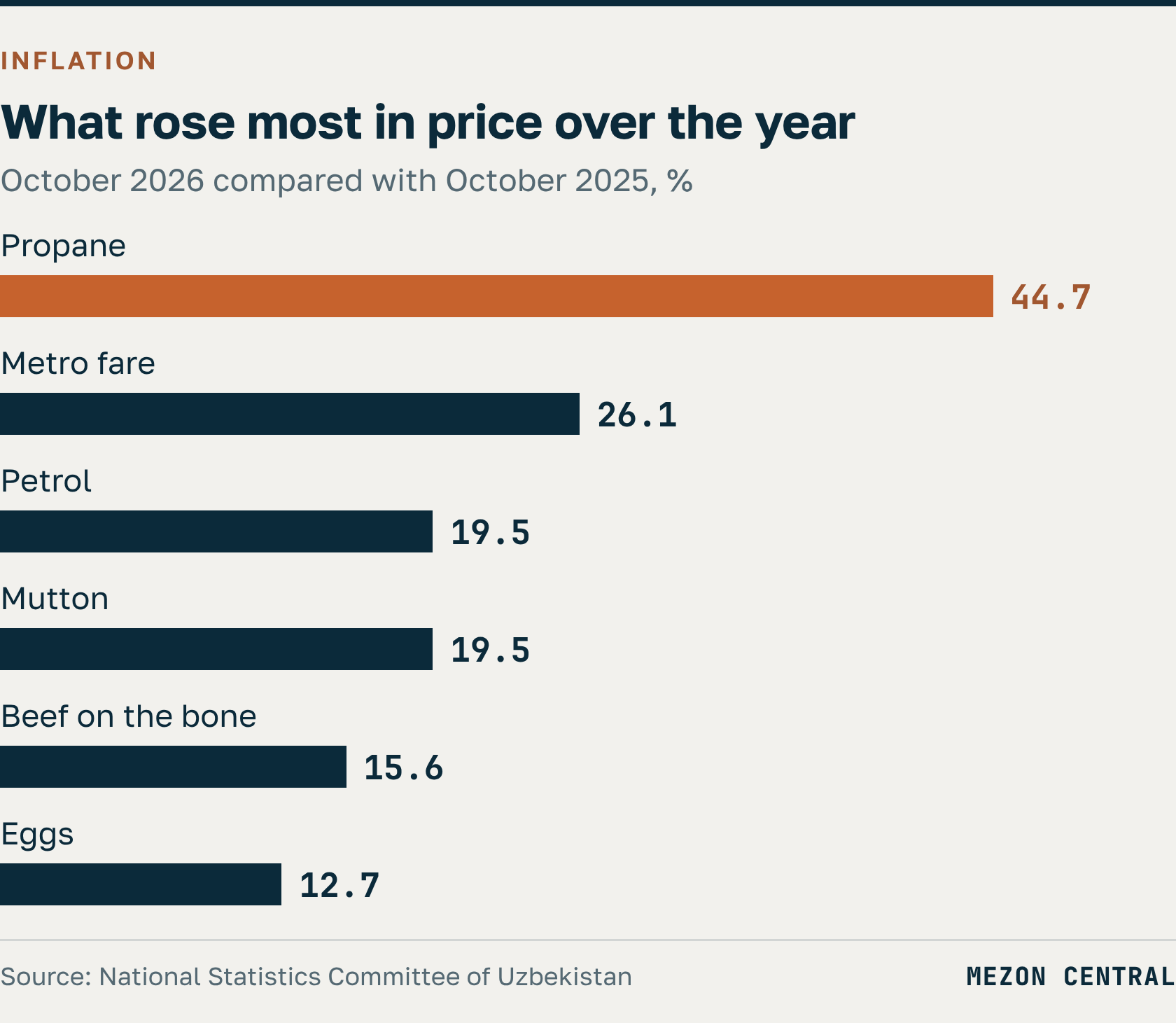
The highest monthly inflation was in Tashkent, at 0.9%, which coincided, among other things, with higher fares on the city’s public transport. The highest annual inflation was also recorded in the capital: 7.4%.
And if we count unofficially?
How well do the official figures match what Tashkent residents feel? And is there an alternative source of price data at all? There is: Numbeo, the world’s largest database on the cost of living and a crowdsourced global source of data on quality of life.
Its cost-of-living rankings are built on data collected from users. It also has information on the cities of Central Asia, including Tashkent.
These data differ from the figures published by the National Statistics Committee.
Using Numbeo’s data, we worked out what a month of life in the capital costs. We did not take every product, item and service that Numbeo lists. Instead we made our own list of what a comfortable life cannot do without. An important point: we mean a comfortable life, in which a person can cover not only basic needs but also go to a restaurant, have a drink and work out. We did not count, for example, trips by private car, other entertainment or buying clothes.
| Item | Quantity |
|---|---|
| Mobile phone | 1 month |
| Internet | 1 month |
| Apples | 3 kg |
| Tomatoes | 4 kg |
| Utilities | 1 month |
| Chicken breast | 4 kg |
| Eggs | 24 |
| Water | 30 bottles of 1.5 l |
| Bananas | 2 kg |
| Local cheese | 1 kg |
| Milk | 10 l |
| Local beer | 10 bottles of 0.5 l |
| Gym membership | 1 month |
| Potatoes | 5 kg |
| Bread | 15 kg |
| Cappuccino | 30 cups |
| Meat | 3 kg |
| Onions | 3 kg |
| Public transport | 60 trips |
| Lunch in a café | 30 times |
| Rice | 2 kg |
| Cigarettes | 20 packs |
| Rent of a one-room flat on the edge of the city | 1 month |
The result is a basic basket: not exactly frugal, but not lavish either. Yes, you could say people can do without lunches in a café or the gym. And there is no need to buy a cappuccino every day; better to make coffee at home. Yes, you can. But first, that is no longer a story about comfort and peace of mind but rather about survival. And second, there will be other costs that also add to a person’s total spending. Someone may not drink coffee but prefers the theatre or the cinema; someone else skis or snowboards in the mountains instead of going to the gym and counts that hobby among their basic costs.
And frankly, leaving these items out would hardly give a true picture of the cost of living in the capital.
How much a comfortable life takes
Our calculations show that a comfortable life in Tashkent takes more than 12.5 million soums a month. The biggest cost is rent. A one-room flat on the edge of the city comes to about 4.8 million soums. Aim for a flat in the centre or a few more square metres, and the price goes up several times over. The next three biggest costs are lunches in a café, coffee and the gym.
| Item | Cost, soums |
|---|---|
| Mobile phone | 55,684 |
| Internet | 163,385 |
| Apples (3 kg) | 54,375 |
| Tomatoes (4 kg) | 80,267 |
| Utilities | 798,401 |
| Eggs (24) | 44,042 |
| Water (30 bottles of 1.5 l) | 141,594 |
| Bananas (2 kg) | 42,714 |
| Chicken breast (4 kg) | 199,000 |
| Cappuccino (30 cups) | 972,353 |
| Gym membership | 842,018 |
| Milk (10 l) | 157,908 |
| Local beer (10 bottles of 0.5 l) | 250,000 |
| Local cheese (1 kg) | 95,917 |
| Meat (3 kg) | 447,923 |
| Potatoes (5 kg) | 34,996 |
| Onions (3 kg) | 14,498 |
| Public transport (60 trips) | 104,400 |
| Bread (15 kg) | 297,647 |
| Rice (2 kg) | 39,500 |
| Lunch in a café (30 times) | 2,400,000 |
| Cigarettes (20 packs) | 480,000 |
| Rent of a one-room flat on the edge of the city | 4,849,475 |
| Total | 12,566,096 |
Is it all bad? Not quite, but there is not much to celebrate either. In its ranking for the first half of 2026, Numbeo put Uzbekistan’s capital third for the cost of living. Only Astana and Almaty are more expensive. Yet Tashkent was once considered one of the cheapest cities in Central Asia.
| City | Cost of living index | Rent index | Cost of living plus rent index | Groceries index | Restaurant price index | Local purchasing power index |
|---|---|---|---|---|---|---|
| Almaty | 38.7 | 16.2 | 28.4 | 39.7 | 40.8 | 51.5 |
| Astana | 32.8 | 12.6 | 23.6 | 34.8 | 31.0 | 62.5 |
| Tashkent | 30.7 | 13.3 | 22.8 | 34.3 | 26.7 | 52.8 |
| Bishkek | 29.9 | 12.8 | 22.1 | 30.3 | 27.5 | 39.6 |
| Dushanbe | 28.7 | 11.4 | 20.8 | 37.1 | 20.2 | 41.7 |
In the global index, Tashkent is in 487th place. And the cost of living here turned out to be higher than in, for example, Jakarta or the Ukrainian cities of Dnipro, Odesa and Kharkiv.
What a salary and a pension will cover
Can a Tashkent resident on the average salary afford these costs? Let us see. According to Uzbekistan’s National Statistics Committee, the average nominal wage in Tashkent for January–September 2026 reached 12.3 million soums. The median wage (the income level that splits all workers into two equal halves. — Mezon Central) in the city is about 6.79 million soums.
Even on the average salary, a comfortable life does not work out. You would have to give up either lunches in a café or coffee. The only way to hope for a relatively easy life is to own your flat. Rent makes up 38.6% of spending, so without it you could afford a little more.
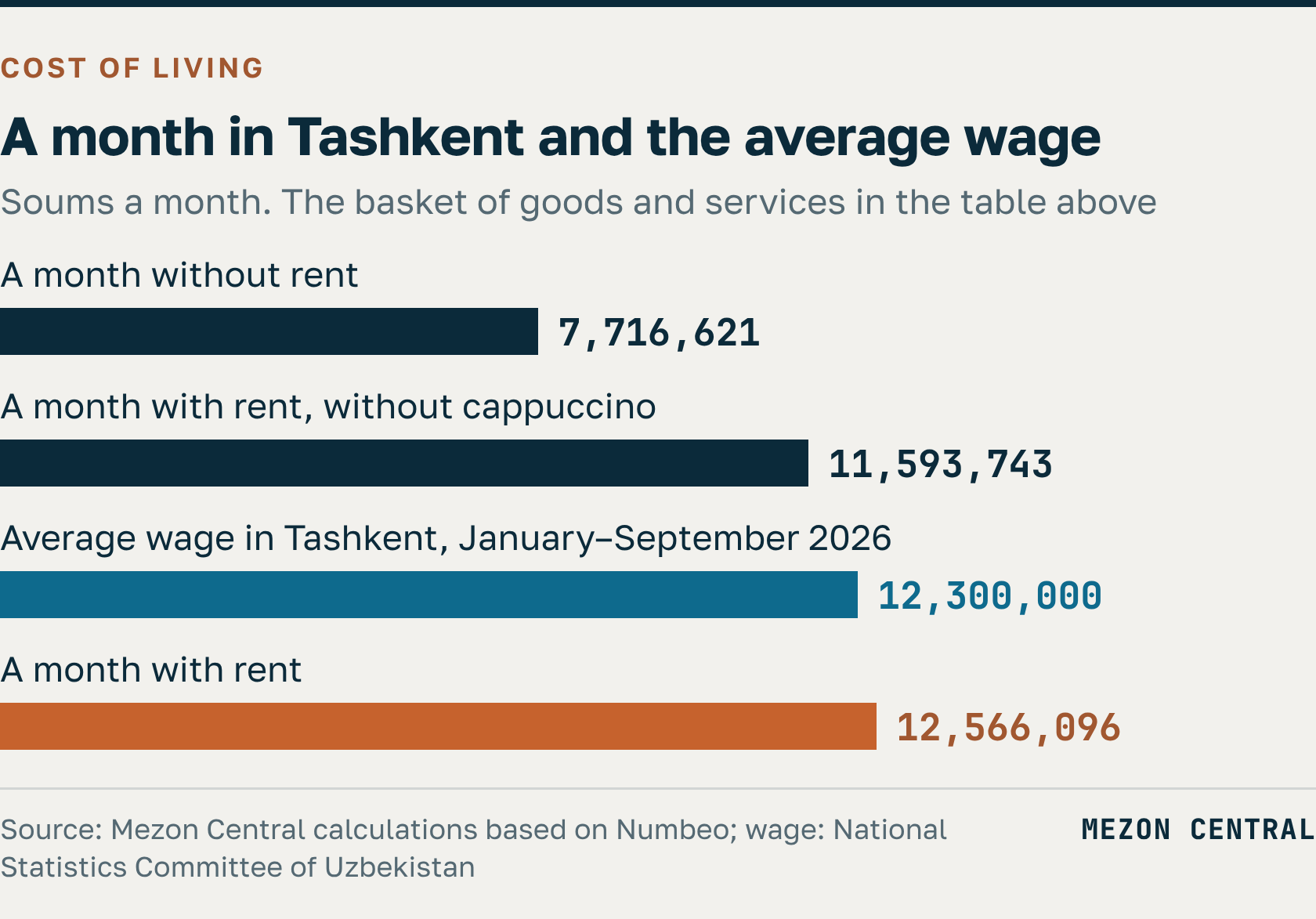
Compared with the median wage, the picture gets truly bleak. The median wage is almost half the cost of our basic basket of goods and services in Tashkent. Even without rent, the median wage would still not cover the basics.
This gap shows clearly that life is in fact much more expensive and harder than official reports suggest. Remember that we did not count spending on, say, clothes and shoes or health, and these also take up a fair share of our monthly budget. So even without extras like restaurants and gyms, living in Tashkent is not just expensive. It is very expensive.