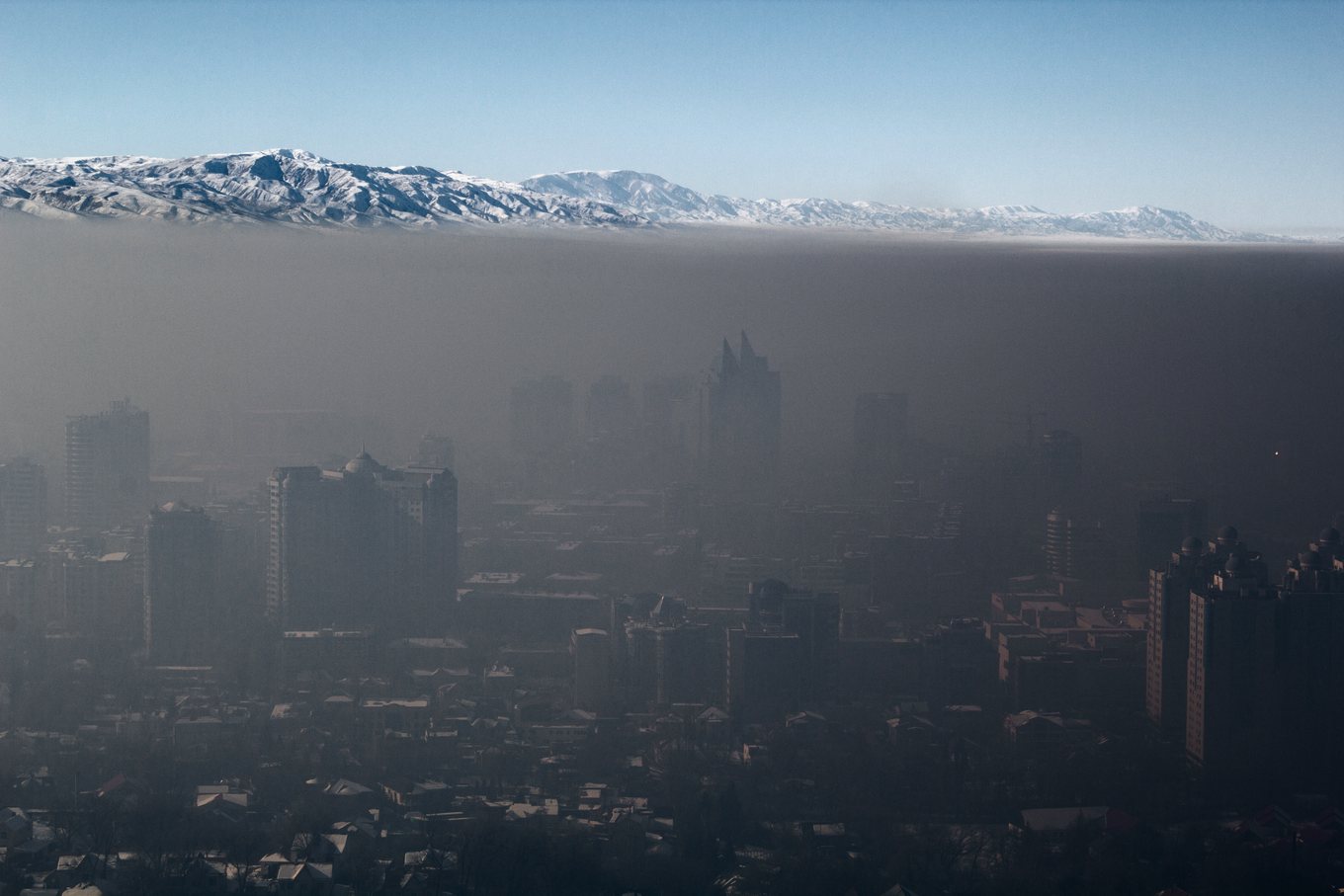

“The city is suffocating”, “Our capital tops the world ranking for polluted air”, “Nothing to breathe! City residents in danger!” and so on. Headlines like these fill the news feeds of Central Asian media. The names of the cities change (Tashkent, Bishkek, Almaty, Dushanbe), but the substance stays the same: smog, the constant companion of the heating season, how to beat it, and “it is not our fault”, which is what city officials say about themselves.
Why are the region’s big cities wrapped in a toxic cloud of fumes as soon as the cold sets in, while all the known solutions simply do not work? How does the policy of municipal authorities make the problem worse? Why is smog so harmful and what illnesses does it cause? We take a closer look.
What is smog and how does it form?
Smog is an aerosol made up of smoke, fog and dust. It is characterised by high concentrations of pollutants: fine particulate matter, PM2.5 and PM10, as well as soot, carbon monoxide and nitrogen oxides. It occurs in industrial cities, and where humidity is high it also contains droplets of liquid.
In 1905 the physician Henry Antoine Des Voeux first used the term “smog” to describe the state of the air in cities. But the word itself, formed from two English nouns, smoke and fog, appeared in 1880 in an American newspaper.
Environmental scientists later divided smog into four types: photochemical (summer), winter (sulphurous), volcanic and Alaskan ice smog.
But it is the second type that concerns us. In winter, city air fills with the waste products of burning fossil fuels to heat homes and businesses. The problem is made worse by inversion. This is an atmospheric phenomenon in which air temperature rises with altitude instead of falling. In other words, in normal conditions smoke from a fire rises, but during an inversion it spreads along the ground. Harmful emissions stay in the atmosphere, where they react chemically and form a haze. It is called “London smog”. It was first recorded in the British capital as far back as 1306, under King Edward I.
Why has smog appeared in Central Asia?
The region lies in the global “dust belt”, which includes the Karakum, Kyzylkum, Aralkum and other deserts. With dry spells and climate change, the risk of dust building up is growing. Hence the sharp deterioration in air quality in Central Asia’s big cities. Tashkent is no exception, though it is not yet considered the dirtiest city. The AQI in the Uzbek capital rose from 93 to 164, and PM2.5 levels also remain high.
Meanwhile, in Kazakhstan the number of cities where air pollution has reached a critical peak has risen from four to ten. Bishkek is fourth in the world ranking for dirty air.
Scientists name the weather as the main cause.
Because the average daily temperature is unstable, pollutants (a mix of natural dust and emissions from vehicles and industrial plants. – Note by Mezon) build up in the atmosphere and disperse poorly.
Are coal, burning rubbish and poor construction the main causes of smog?
Environmentalists say they are. In a comment to Mezon, the expert Dmitry Pereyaslavsky stressed that burning coal releases smoke, particulate matter, heavy metals and chemical compounds into the atmosphere: sulphur oxide, nitrogen oxides and carbon dioxide. More often than anything else, it is coal burning that drives the formation of winter smog, along with chaotic development that disrupts the city’s wind patterns.
“But it is not only coal that is burned. Rubbish is burned in stoves too. Some private bathhouses do this as well: they work around the clock and use waste as fuel. Burning rubbish within city limits is unacceptable. Waste must be disposed of at designated sites and facilities that ensure the necessary combustion temperature of at least 1,000 degrees,” says the environmentalist Pereyaslavsky.
The expert names urban development as another cause of pollution.
When a master plan is drawn up, the direction of the winds must be taken into account and corridors that ventilate the city must be preserved, which includes not building on plots that matter for the movement of air.
Dmitry Pereyaslavsky
Bulat Yessekin from Kazakhstan, founder and coordinator of the Central Asian Platform on Water Resources Management and Climate Change, agrees with Pereyaslavsky. In his view, the rapid growth of cities and of the construction sector contributes to smog, because planning no longer takes into account the environmental capacity of a settlement.
“Almaty, for example, lies in a basin where ventilation is difficult. By the estimate I have cited, the city’s environmental capacity is about 550,000 residents, but the actual population has grown considerably. The expansion of cities is closely tied to the interests of developers and the decisions of local authorities. Every new housing complex means more cars, more water and electricity consumption, more wastewater, more load on the heating system and new traffic jams. And yet construction continues. At present, in my estimation, business interests take priority, and the powers of the environmental authorities have been significantly weakened,” said Bulat Yessekin.
That is why environmental limits must be taken into account, requirements for polluters tightened, and environmental inspectorates and the public given effective means of control again.
Bulat Yessekin
Residents of private houses should be banned from burning rubbish, rubber and household waste and from heating with poor-quality, high-ash coal. But rules, Yessekin argues, must not simply be introduced: compliance must be ensured. Those who do not follow them should be fined.
Does smog affect the climate?
The answer is yes, through black carbon. These are fine solid particles in the smoke of wildfires and in the exhaust of diesel vehicles. Black carbon is very fine and, because of its size, can travel thousands of kilometres through the atmosphere. When it settles on the ice of the Arctic Ocean and Greenland, it changes the reflectivity of the Arctic Ocean.
Ice and snow change colour, becoming less white, and absorb heat instead of reflecting it back into space. This in turn contributes to global warming.
Why is smog so dangerous to health?
Smog reduces lung function and causes shortness of breath, wheezing and coughing.
It can lead to asthma, cancer, Alzheimer’s disease, birth defects, low birth weight, high blood pressure and stroke.
Why can’t the authorities beat smog?
It would be wrong to say that nothing is being done to fight the acrid haze. But why does none of the existing machinery work? The smog hangs over the cities just as it always has. Year after year, residents of the region’s capitals have breathed poisoned air, and they still do.
“In my view, the relevant agencies are not working effectively enough: instead of taking concrete action, they shift responsibility onto residents, urging them, for example, to use their cars less and not to heat with coal. But people have the right to live in a warm home and to get around by car. Real measures are needed: insulating homes, energy-efficient stoves, support for households through grants or soft loans instead of simply handing out coal, and a list of businesses that meet environmental standards and use modern filters. Public bathhouses with cleaner heating systems could also be put on that list. Industrial sites can be influenced through regulation and inspection. In the past, plants were more often placed in dedicated industrial zones, whereas today industrial buildings often end up inside city limits. Urban planning must take into account the wind rose and the relative positions of housing and sources of emissions,” says Dmitry Pereyaslavsky.
All decisions must be consistent with one another and take into account the city’s actual conditions.
Dmitry Pereyaslavsky
“We need measures to cut emissions from burning coal and to move gradually to cleaner energy sources, including renewables and gas where that is justified. Continuous automated monitoring, fuel quality control, fines for burning rubbish and low-grade coal, and modern emission control technology at power plants are all needed,” says Yessekin, backing Pereyaslavsky’s position, and he points to the countries of the European Union as an example.
Europe’s experience shows that air quality can be improved through strict legislation, requirements for polluters and clean-up technologies, and penalties for violations. London also suffered from severe smog in the past, but the situation was turned around through tough regulation.
Bulat Yessekin
According to the expert, environmental requirements in the Central Asian countries exist on paper rather than in practice. The authorities give priority to attracting investment and developing business, while environmental control has been pushed to the sidelines. As a result, businesses operate without environmental restrictions.
“In Kazakhstan, for example, an inspector cannot simply turn up at a plant for an unscheduled inspection. It has to be approved in advance, and producers are notified of scheduled inspections beforehand. This gives them a chance to prepare and hide their real emissions. In my view, restricting the powers of the inspectorates and weakening environmental control contribute to the growth of pollution in cities,” added Bulat Yessekin.
The main thing is to define the goal of state policy correctly. In our programmes, the main indicators are often the volumes of emissions a business is responsible for, while better air quality is not a goal in its own right for which someone is held accountable. Pollutant concentrations and maximum permissible concentrations (MPCs) are recorded but often remain merely informational. They are measured without being tied to a binding result for a business or a local administration.
Bulat Yessekin
Where does it go wrong?
In the European approach, standards and directives set requirements for technology and for the use of the best available techniques to fight smog. In Central Asia, experts note, the system relies on calculated limits.
A business can commission a calculation of its permissible emissions and then seek approval of the figures without investing in real improvements.
The calculation takes various parameters into account: the wind rose, background pollution, the height of the emission source, deposition coefficients and the efficiency of the equipment. But if the data are manipulated, a formally acceptable limit can be obtained. So the fight against smog often turns out to be no more than an imitation.